
Property investment is evolving fast and joint ventures now account for a significant share of large-scale real estate deals. Most people think property investment means going it alone with all the risk on your shoulders. That idea is outdated because collaboration in joint ventures lets investors take on much bigger projects with shared risks and much greater rewards.
Table of Contents
- What Is A Property Joint Venture?
- Why Are Property Joint Ventures Important?
- How Do Property Joint Ventures Function?
- Key Concepts In Property Joint Ventures
- Real-World Examples Of Property Joint Ventures
Quick Summary
| Takeaway | Explanation |
|---|---|
| Collaborate to Share Risks | Property joint ventures help distribute financial and operational risks among partners. This reduces individual vulnerability in property investments. |
| Leverage Complementary Skills | Participants bring unique strengths, such as capital or market expertise, enhancing project potential and execution. |
| Structured Legal Frameworks are Essential | Clearly defined agreements outline roles, contributions, and returns, ensuring successful collaboration and protecting interests. |
| Access Larger Investment Opportunities | Joint ventures enable investors to pursue more ambitious and complex properties than they could individually manage. |
| Governance Keeps Projects on Track | Effective governance structures prevent conflicts and ensure smooth decision-making, maintaining project momentum throughout the venture. |
What is a Property Joint Venture?
A property joint venture represents a strategic collaboration between two or more parties who combine their resources, expertise, and capital to develop, purchase, or manage real estate assets. These partnerships enable investors to leverage collective strengths and mitigate individual risks associated with property investments.
Core Structure of Property Joint Ventures
In a typical property joint venture, participants bring different yet complementary capabilities to the project.
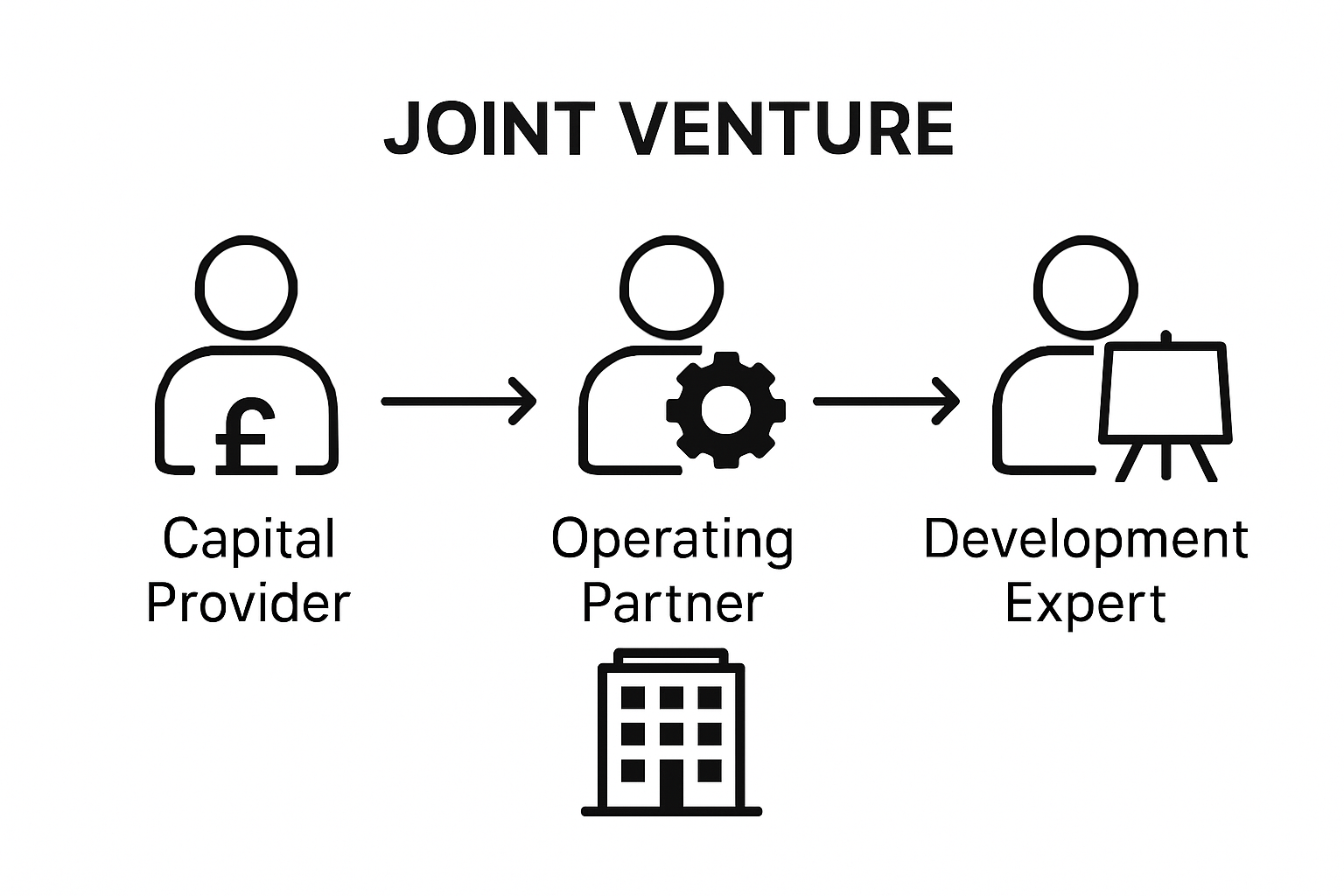
The primary parties often include:
- A capital provider who contributes significant financial resources
- An operating partner responsible for project management and strategic execution
- Individuals or entities with specific property development expertise
According to Cornell Law School, a joint venture involves parties sharing both potential profits and inherent risks of a specific enterprise. In property contexts, this means each participant has a defined role and financial stake in the project’s success.
Financial and Strategic Benefits
Property joint ventures offer numerous advantages for investors seeking to expand their portfolios without shouldering complete financial and operational burdens. Participants can access larger, more complex property opportunities that might be challenging to pursue individually. The collaborative approach allows for:
- Risk distribution across multiple stakeholders
- Pooling of specialized knowledge and skills
- Enhanced financial capacity for ambitious projects
- Potential tax and legal structure optimisations
As RICS Journal highlights, these arrangements have become increasingly popular in complex property development scenarios, where multiple expertise streams are crucial for successful project completion.
Whether you are a seasoned property investor or exploring new investment strategies, understanding the mechanics of property joint ventures can unlock significant opportunities in the real estate marketplace.
Why Are Property Joint Ventures Important?
Property joint ventures represent a strategic approach to real estate investment that enables investors to overcome individual limitations and unlock significant opportunities. By combining resources, expertise, and capital, participants can achieve more ambitious property development goals than they could independently.
Risk Mitigation and Resource Pooling
One of the primary reasons property joint ventures are crucial is their ability to distribute financial and operational risks across multiple stakeholders. This collaborative model allows investors to:
- Spread potential financial exposure
- Access larger property investment opportunities
- Share complex project management responsibilities
- Leverage diverse skill sets and professional networks
According to Accounting Insights, collaborating through joint ventures enables parties to pursue projects that might be unattainable when working in isolation.
Strategic Advantages in Property Development
Property joint ventures offer substantial strategic benefits beyond simple risk sharing. Experienced investors can combine complementary strengths, creating powerful synergies that enhance project potential. For instance, one partner might contribute substantial capital while another brings deep local market knowledge and development expertise.
These partnerships also provide flexibility in property investment strategies, allowing participants to:
- Target more sophisticated property development projects
- Minimize individual capital requirements
- Access specialized market insights
- Create innovative investment structures
Moreover, joint ventures enable investors to navigate complex property landscapes more effectively, transforming potential challenges into collaborative opportunities for growth and success.
How Do Property Joint Ventures Function?
Property joint ventures operate through carefully structured agreements that define each participant’s roles, responsibilities, financial contributions, and expected returns. These complex collaborations require meticulous planning and clear legal frameworks to ensure successful project execution.
Structural Frameworks and Participant Roles
Successful joint ventures rely on well-defined participant contributions. Typically, partners are categorised into specific roles that complement each other:
- Capital providers who contribute significant financial resources
- Operational experts managing project development
- Technical specialists offering specific property expertise
- Legal and financial advisors structuring the venture
According to Cornell Law School, these collaborations involve parties sharing both potential profits and inherent project risks through a structured enterprise.
Legal and Financial Mechanisms
Property joint ventures are commonly established through two primary legal structures:
- Limited Companies: Creating a separate corporate entity
- Limited Liability Partnerships (LLPs): Providing flexible partnership arrangements
These structures allow partners to create special purpose vehicles that isolate project risks and provide clear financial accountability. Partners establish detailed agreements specifying:
- Capital contribution percentages
- Profit distribution mechanisms
- Decision making processes
- Exit strategies
Read more about how these property investment strategies can be implemented effectively in complex real estate projects. The legal framework ensures transparency and protects each participant’s interests while facilitating collaborative property development efforts.
To help clarify the various roles participants can take within a property joint venture, the following table outlines common joint venture roles and their corresponding responsibilities.
| Role | Main Responsibilities |
|---|---|
| Capital Provider | Supplies financial resources, assumes financial risk |
| Operating Partner | Manages project development and strategic execution |
| Technical Specialist | Offers specific expertise in property development |
| Legal Advisor | Structures agreements, ensures legal compliance |
| Financial Advisor | Oversees accounting, financial planning, and reporting |
Key Concepts in Property Joint Ventures
Property joint ventures encompass several critical concepts that define their structure, operation, and potential for success. Understanding these fundamental principles helps investors navigate complex collaborative property investment strategies effectively.
Capital Contribution and Equity Allocation
Capital contribution represents the financial foundation of any property joint venture. Participants typically contribute resources through various mechanisms:
- Direct monetary investments
- Property assets
- Professional expertise
- Development capabilities
- Intellectual property or market access
The equity allocation directly corresponds to each partner’s contribution, determining their proportional ownership, risk exposure, and potential returns. Precise documentation of these contributions is crucial to prevent future disputes.
Risk Sharing and Performance Metrics
Successful property joint ventures establish clear frameworks for:
- Identifying potential project risks
- Allocating risk responsibilities
- Defining performance benchmarks
- Creating transparent evaluation mechanisms
Investors must develop comprehensive property investment strategies that outline specific performance indicators, enabling objective assessment of the joint venture’s progress and effectiveness.
Governance and Decision Making
Effective joint ventures require robust governance structures that define:
- Voting rights
- Management responsibilities
- Conflict resolution mechanisms
- Communication protocols
These governance frameworks ensure smooth collaboration, preventing potential deadlocks and maintaining project momentum through clear, predefined decision making processes.
This table summarises key components and characteristics of property joint ventures, helping readers to quickly understand the structural and operational features central to joint venture success.
| Feature | Description |
|---|---|
| Capital Contribution | Partners invest cash, assets, expertise, or other resources |
| Equity Allocation | Ownership shares correspond to contribution levels |
| Risk Sharing | Financial and operational risks distributed among participants |
| Governance Framework | Defines decision making, roles, and conflict resolution |
| Legal Structure | Usually set up via Limited Company or LLP with clear agreements |
| Performance Metrics | Benchmarks and evaluation systems to measure progress and success |
| Exit Strategy | Agreed processes for ending the collaboration and allocating returns |
Real-World Examples of Property Joint Ventures
Property joint ventures manifest across diverse real estate sectors, demonstrating their versatility and strategic potential for investors seeking collaborative development opportunities. These practical examples highlight how different stakeholders can successfully combine resources to achieve complex property investment objectives.
Commercial Property Development Collaborations
Large-scale commercial developments often rely on joint venture structures to manage complex financial and operational challenges. Consider a scenario where:
- A property investment firm provides substantial capital
- A local developer contributes site expertise and planning knowledge
- A construction company offers technical implementation capabilities
In one notable example, Securities and Exchange Commission documentation reveals a multifamily residential community joint venture that successfully sold its assets for $77.8 million, demonstrating the potential for significant returns through strategic partnerships.
Hospitality and Mixed-Use Project Partnerships
Joint ventures excel in intricate property developments requiring specialized expertise. An illuminating instance involves a hotel development partnership at the University of Notre Dame, where:
- One partner contributed initial land and conceptual design
- Another partner provided construction financing
- A third partner managed operational implementation
This collaborative approach enables investors to tackle ambitious investment strategies that would be challenging to execute independently.
Residential High-Rise and Luxury Development Ventures
In metropolitan markets, property joint ventures facilitate complex residential developments. A New York City high-rise luxury condominium project exemplifies this model, where multiple partners:
- Shared significant land acquisition costs
- Distributed development and construction risks
- Leveraged collective financial and technical capabilities
These real-world examples underscore how property joint ventures transform ambitious property concepts into successful, profitable realities through strategic collaboration.

Take Your Property Joint Ventures Further with Sylvest
Are you struggling to find the right partners or secure the best opportunities for your next joint venture? This article has shown how joint ventures can open doors to bigger, more rewarding projects, yet the challenge remains in coordinating resources, managing risk, and connecting with trusted collaborators. Many ambitious investors are held back by limited networks, uncertain deal sources, and the complexity of finding joint venture opportunities that truly match their goals.

Transform the way you invest in property. At Sylvest.co.uk, you gain instant access to a community designed for collaboration and seamless deal discovery. Explore property investment strategies, connect directly with experienced estate agents and deal sourcers, and get matched with partners who share your vision. No more wasted time or missed opportunities. Join our marketplace today and let your next joint venture start with confidence. Begin your property investment journey now at Sylvest.co.uk, or dive deeper into effective property investment strategies.
Frequently Asked Questions
What is a property joint venture?
A property joint venture is a collaboration between two or more parties who combine their resources, expertise, and capital to develop, purchase, or manage real estate assets.
What are the benefits of entering into a property joint venture?
Property joint ventures offer several advantages, including risk distribution among stakeholders, access to larger investment opportunities, pooling of specialized knowledge, and enhanced financial capacity for ambitious projects.
How do property joint ventures manage risks?
Property joint ventures mitigate risks by distributing financial and operational responsibilities across multiple participants, allowing for shared exposure and the ability to tackle more complex projects collectively.
What are the common roles in a property joint venture?
Common roles in a property joint venture include capital providers who finance the project, operational partners who manage development, and technical specialists who contribute specific expertise, all working collaboratively to ensure project success.
Leave a Reply